Saturday, January 3, 2009

It has been cold!

Since my Christmas break began the weather has thrown all kinds of cold stuff at us.
Deep snow, blowing winds, and low temperatures. The 100 feet between my house and studio sometimes has made me feel like Admiral Bird trying to get back and forth. This past week I have been able to spend time throwing pottery in the studio and things went very well. My studio heats with wood so it takes some time every morning to warm it up enough to work in it. But this morning I saw that the mercury dropped considerably the night before, meaning that I came into the studio to be greeted by this:

Frozen pottery. Imbeded with ice crystals. When they thaw they will collapse.

Friday, December 19, 2008

Year of the Rat

More underglaze work.


In particular I made this as a "Secret Santa" gift for a friend who was born in the "Year of the Rat" as determined by Chinese Astrology. So was her infant son. Probably it isn't surprising that it's not all that easy to find rat themed ceramics.


I was quite happy with the way it turned out. Click on the picture for detail.

And here is some ratty detail.

Sunday, December 14, 2008

Working With Color

I love modern pottery styles as well as Medieval. The earthyness and simple function of the Medieval ware is so satisfying, but I can't ignore my love of color and the more unusual shapes of contemporary ceramic ideas. This means they often are merged in my work such as with this platter:

The design is a Turkish Phoenix from the Middle Ages. But this Phoenix is done with modern underglazes on a white stoneware platter and fired to cone 6.

In another application, this is the same design I painted on my Medieval Pavilion. It reminds me of the beautiful July day when this photo was taken. A comforting thought on this below zero December evening.
But I was talking about color in pottery not the weather, so here is some of the greens on which I have been concentrating recently:


If you click on the photo to make this big the surface design is also apparent. It's subtle from a distance, but a closer look shows the amount of work that goes into each piece.


And the huckleberry purples! Now these are bright glazes, and so lovely. Yes, these bright colors can be achieved using stoneware glazes and temperatures. This photo was taken at the "Mud and Spirits" show in Coeur d'Alene, ID, sponsored by C.A.G.N.I. the weekend before this one. We were lucky, the bad weather didn't start until this Saturday and the road to and from Coeur d'Alene was great.

Saturday, June 28, 2008

A visitor in my studio

He didn't enjoy his time in the studio, rather he flung himself at the window repeatedly. After trying to help herd him to the open doors, I finally just left the studio and came back sometime later to find that he had left. He is obviously frightened in this picture, but what a pretty bird!

Thursday, June 26, 2008

Ceramic Cookware

Although Pipkins are a favorite, they aren't the only Medieval cooking pot. I make a variety of other Medieval cooking pots for the firepit or brazier too.

A very basic cooking pot is a round bottom piece. Simple ceramic cooking pots are literally found all over the world and all through time for cooking. A few show surface decoration, although it was probably to help the cook get a good grip on a slick piece of pottery. The Ashmolean Museum has some good examples of round-based cooking pots: http://potweb.ashmolean.org/PotChron2a.html


This little brown bowl on tripod feet is about 2 cups in capacity and can be used for various culinary work. I especially picture it for sauces or warming up a small amount of water.


The green pouring bowl is 2 qt. size and is also on three feet to fit on the coals. Of course, these bowls have many, many uses on the kitchen counter as well as on a firepit.
"Pre-industrial Utensils; 1150-1800" published by the Museum Baymans-van Beuningen, Rotterdam is an excellent reference and the one I like for these bowls.


This is a good example of a skillet. With an interior of about 5" in diameter, this becomes an excellent size for a pancake or frying a couple of eggs. The handle is hollow for insulation like I make many of my pipkin handles. Although this fry pan is on tripod feet too, I also make them with a flat base. My favorite example of this in history is used in a painting by Pieter Aertsen titled "The Pancake Bakers".


The cauldron can be used for anything a pipkin can be used for. I particularly like them for baking, I just scoot mine to what looks like the optimum coals and keep an eye on the heat to insure the coals don't get too hot or cool down too much. There are many examples of medieval cauldrons, the Museum of London has some of my favorites, for example this "London Ware": http://www.museumoflondon.org.uk/ceramics/pages/subcategory.asp?subcat_id=796&subcat_name=London%2Dtype+ware


You can see a bit of the tripod feet of this Norman spouted jug in this picture. A jug like this can heat water or warm up beverages in the coals. The Ashmolean has a couple of great examples in their "Pot Web" http://potweb.ashmolean.org/PotChron2a.html

Saturday, May 24, 2008

Doing work for June Fair

Next week I'm traveling to Port Gamble to be with friends and participate in June Fair. June Fair is put on by the Barony of Dragon's Laire and is a large event. I've only been to it once before several years before, it comes at a busy time for me. This year with Crown Tourney so far distance for travel I thought it would be a great time to go back to June Fair. It sounds as if many of my friends will be there too.

.
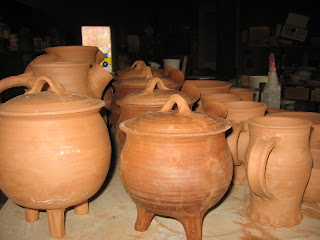
I'm doing a lot of cooking ware for the event. I've been very enthused about cook ware, particularly the pots that go directly on the coals. I've enjoyed cooking in them myself, which makes it natural to spread that enthusiasm. Tripod pipkins, such as those in the picture above, seem the most fun, they are such appealing shapes.
I have also been working on the simpler cooking pots without handles, cauldrons, Anglo-Norman jugs, braisers, pipkins, frying pans, and pouring bowls with feet. The last group of cooking pots I included stamped and carved surface design. Some of the design I covered with glaze, other design I let the warm red clay show off.


This picture shows some of the footed pouring bowls and the porringers. There are also some Anglo-Norman footed jugs in the back of the picture. The jugs also can go on the coals for cooking or for heating water. I like using them too they have multiple uses.
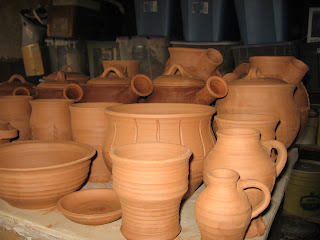
In the foreground are some non-cook pots too, bowls, Medieval goblets, and small jugs with piecrust feet. Actually, I because I use the same clay formulation for these pots as I do the cooking pots they to could be used for cooking in firepits if just that exact shape was needed.

Most of the Medieval cooking pots I have loaded in the kiln waiting to be fired tomorrow I made cooking pots without handles, feet, or lids, and green glazed them. That is I didn't do a bisque firing, but put the glaze on the dried pot. That increases the possibility that some may break, or that the uneveness from throwing or trimming..... if there is any, will cause them to crack in the kiln. I also spent most of the day force-drying the green glazed pots. We will see how successful this was when I unload on Monday.

Friday, May 9, 2008

Some pottery from the Renaissance Fair

The weekend's sunshine helped everything, even when it came to photography of the pottery. The weather was an additional joy to the weekend.

The green ware was popular with people this year. It's the first time in Moscow I've had this glaze style combined with this particular surface decoration on display. I will be making more soon, particularly the decorated mugs on tripod feet which sold out and had people inquiring about more.


Some of the Celtic knotwork I had available. These are time-consuming to create, but of course I love to do them. I go through phases when I become obsessed with a particular Celtic or Viking animal to engrave. This depends on what animal I am thinking of or noticing during my non-pottery hours.


Huckleberry glaze series. I like the glaze with the small coil on the rim, such as the bowl on the top left. It gives the pot a subtle elegance that just seems to work with the purples. Huckleberries are precious things for me and I intend to go hunting for the real things this summer after a long hiatus.

And, of course, my dragon ware, nestled amongst the Celtic knotwork.