Showing posts with label medieval pottery. Show all posts

Thursday, March 5, 2009

Some pottery for March

I've been working on pottery that I will have at AnTir's Kingdom Arts and Sciences event, March 7-8th, 2009. I'm going to have a merchant's table there and hope to also have some of the pottery of my friends Gwen the Potter and blown glass pieces by Aelfgu.

The following pottery pieces are some of my most recent work out of the kiln.


I particularly like this jug. The soft colors are unusual and came out very successfully. The herringbone carved design is French in origin.


This pitcher-type is a very different style from the green and yellow baluster jug above. My spouted pouring vessels like this can also be used on direct heat.


I tried a few different things with this saucepan. It's thrown out of earthenware clay rather than stone ware and it's fired to a lower temperature more like period pottery. Unlike period pottery it has a food safe glaze that I formulated, and then again like period pottery for color I sprinkled some copper filings on the wet glaze to get that green speckle you see.
This pot is also intended for cooking in coals.

A simple cooking pot. Well, it should have been simple, but I couldn't resist carving some surface design on the pot. This will help the user hold onto it when it gets wet too.

Saturday, May 24, 2008

Doing work for June Fair

Next week I'm traveling to Port Gamble to be with friends and participate in June Fair. June Fair is put on by the Barony of Dragon's Laire and is a large event. I've only been to it once before several years before, it comes at a busy time for me. This year with Crown Tourney so far distance for travel I thought it would be a great time to go back to June Fair. It sounds as if many of my friends will be there too.

.
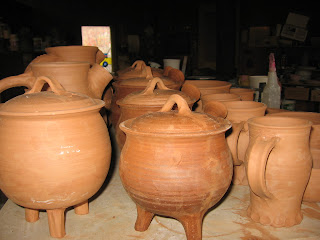
I'm doing a lot of cooking ware for the event. I've been very enthused about cook ware, particularly the pots that go directly on the coals. I've enjoyed cooking in them myself, which makes it natural to spread that enthusiasm. Tripod pipkins, such as those in the picture above, seem the most fun, they are such appealing shapes.
I have also been working on the simpler cooking pots without handles, cauldrons, Anglo-Norman jugs, braisers, pipkins, frying pans, and pouring bowls with feet. The last group of cooking pots I included stamped and carved surface design. Some of the design I covered with glaze, other design I let the warm red clay show off.


This picture shows some of the footed pouring bowls and the porringers. There are also some Anglo-Norman footed jugs in the back of the picture. The jugs also can go on the coals for cooking or for heating water. I like using them too they have multiple uses.
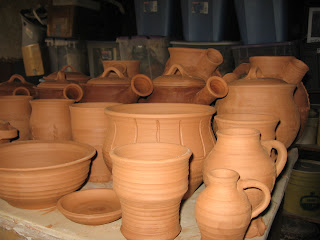
In the foreground are some non-cook pots too, bowls, Medieval goblets, and small jugs with piecrust feet. Actually, I because I use the same clay formulation for these pots as I do the cooking pots they to could be used for cooking in firepits if just that exact shape was needed.

Most of the Medieval cooking pots I have loaded in the kiln waiting to be fired tomorrow I made cooking pots without handles, feet, or lids, and green glazed them. That is I didn't do a bisque firing, but put the glaze on the dried pot. That increases the possibility that some may break, or that the uneveness from throwing or trimming..... if there is any, will cause them to crack in the kiln. I also spent most of the day force-drying the green glazed pots. We will see how successful this was when I unload on Monday.

Saturday, November 17, 2007

Palouse Potters at Cowgirl Chocolates

Platter with purple glazes, I am going to keep working on this style!


The Palouse Studio Potters Guild Show at Cowgirl Chocolates begins Saturday, Nov. 17th. and goes through the Christmas season. We are holding a reception that afternoon as well with snacks. Marilyn has been very generous with us. Still, space requirements are such that we can't bring many items, so I am arguing with myself over what I want to bring. When they sell, I will replace them.

These pitchers are influenced by
the Medieval 'baluster' shape
but the surface decoration, glazes,
and glaze application are 21st. Century!!

Whatever the venue, I always want to bring the most recent things that came out of the kiln, although older work might be better sellers....I don't know, if I did know I would be a much wealthier person. Finally got to unload the kiln today. Some worked out well, others not so much. The glaze experiments didn't work out as well as I had hoped they would, the kiln fired at least a cone hotter, possibly more, because I programed a very slow cool-down, the temperature rise is counter-intuitive, but there you go.

This bowl has about a 2 qt. capacity
It really shows off the "huckleberry"
purple glaze


I am still discovering and amazed by the color of these purple glazes when applied to the textures I am using on the pots. The purples are so strong.


Friday, November 9, 2007

More on Medieval Pottery

During the Medieval European era eating from pottery was not favored by the Aristocracy. Wood cuts and illuminated manuscripts of the times show us that ceramic pots were more likely to be found in the kitchens or in the taverns. Still, ceramics were ubiquitous; shards of kiln wasters and broken pottery are found at almost every archaeological site. So many discarded pieces have led some to describe Medieval European pottery as the equivalent of the modern paper plates or Tupperware.

Her Antirian Majesty Miranda Faoltrina prepares to enjoy Amberguard's Harvestfeast.


In our “Modern Middle Ages” though, pottery is a popular and valued craft. People use ceramics for feast ware and there is increased interest in redacting medieval recipes and preparing them with the cooking methods and styles of pottery used during the period. There are some very ugly medieval pots out there. They were a utilitarian tool, often made without adornment and care for the shape. I suspect much of the clay near available near the land’s surface was short, lacking the kaolin that helped make the Chinese clay of the same period so plastic and which resulted in beautiful shapes.


Arthur Dearhurst, Baron Wastekeep, with his balluster drinking jug


I am not interested in replicating work unless I am delighted with it, this encourages me to research until I find shapes I consider strong and beautiful, of which there are aplenty. There exists a variety of styles of many of these medieval mainstays; I choose the styles I make through my own interest, from suggestions of customers and “beta testers”.


Sunday, October 21, 2007

These Medieval clubs

Constantine sautes pork in a pipkin with rice cooking in the lided pipkin on the edge of the braiser.

Chances are you have seen us clashing loudly with swords and armor in city parks, looking comfortable promenading through Renaissance Fairs, or demonstrating everyday activities of a Medieval Household at Libraries.
In particular the medieval organization named The Society for Creative Anachronism, or SCA, has been growing and changing since the 1960s when it began. Now with 30,000 paid members and many more unpaid members. Other than a fervent interest in the medieval era there seems to be very little in common between the individuals Medievalists, who run the gamut of education, professions, age, and aspects of the various medieval organizations they favor. From the extremes of people who just like to party in odd clothing, through the range of those who try to live so authentically among other activities they part with their eye glasses for the weekend event. Most participants, however, fall in between the two extremes and, as much as we love spending weekends camping in pavilions and wearing ‘garb’, we are more than aware that it isn’t possible to be completely medieval and we are happy to be back in a land of refrigerators and central heating when the event has concluded.


Hrafnir Fiachsman roasts a pork loin in a pipkin.


Since the 1960s when the SCA began there has been a noticeable increase in medieval scholarship and putting the crafts and tools of the era to practical use in the form of experimental archaeology. It is not unusual to see a Viking starting his campfires with flint and steel, a Norman grinding the pigments for her Illuminated Manuscripts, or a Celt carving bone needles for embroidery. The focus of my medieval experience is pottery.


Katerjine kneeds bread for baking and uses the jug in the foreground for adding liquid when required. In the background craftsmen prepare to cast pewter. Others enjoy the beautiful day