Saturday, November 29, 2014

Maiolica-Majolica 2

The next step in maiolica I took was when I started painting the cave animals inspired by the Lascaux caves in France on my pottery. I wanted a solid background and wanted a slightly watercolor effect on the glaze painting. Maiolica gives a great surface for watercolor-like effects. Thus I worked on these pots.


Friday, November 28, 2014

Maiolica-Majolica I

These two bowls were my first attempts at Italian Renaissance Maiolica. The shields in the center are often seen in maiolica from this time and place, also the bowls on little pedestals with opposing handles are an oft used design .


I let the idea of maiolica rest for a few years. I liked them, but it took so very long to complete the painting that I concentrated on other things for awhile. But more to come.

Friday, December 6, 2013

Byzantine Pottery Tableware

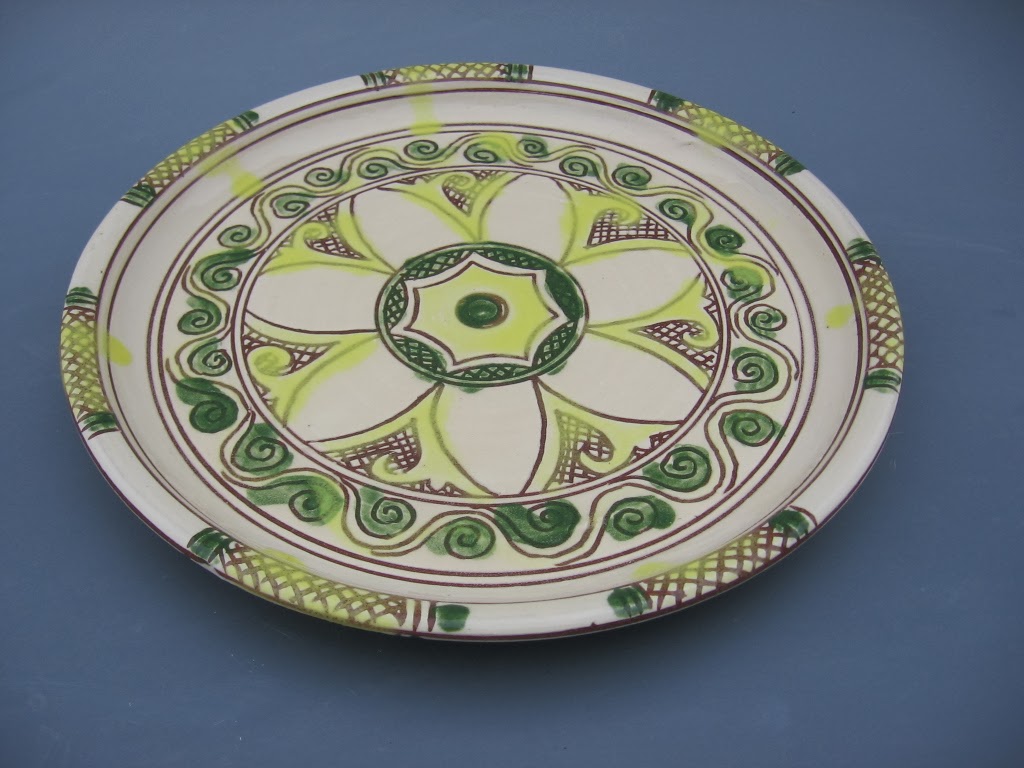
This series of pottery was inspired by the beautiful pottery made in Byzantine Serres. There are several books that have examples but my favorite is Ceramic Art from Byzantine Serres  by  Demetra Papanikola-Bakirtzis.
All my examples are as close to the originals as I can make them. they are red earthenware covered with a white slip. I then carve designs in them, the designs are pretty thick so they are considered "champleve" rather than scraffito. After they have been bisque fired I glaze them with a lead-free transparent glaze (I guess that isn't exactly like the original) and loosely glaze them with green and yellow glazes. The green and yellow are also lead-free. The glazing is very loose and doesn't try to be precise, and that is like the originals.
I have two Byzantine Plates for sale on Etsy: https://www.etsy.com/shop/jeannepottery?page=3


Wednesday, January 16, 2013

Pipkins

I have been researching and writing notes on cooking pots used in the Middle Ages and Renaissance. It is a huge subject. One of the types of cooking pots are pipkins. I have a few other pictures of pipkins in this blog and just wanted to show a few other varieties of pipkins I have made. What seems to make a pot a pipkin is the tripod feet and a handle on only one side of the pot. Lids are not always seen, although there are some. I like using lids when using these to cook, especially over coals, and many people who have my pottery distinctly prefer pots with lids, so I will keep making them.

This style of pipkin has one loop handle, what I have seen most commonly. The lid has a little inside ring, it makes it sit in the pot very well and is quite helpful for cooking. I've seen an example of this style of lid only in an Archaeologist's drawing.  The feet are funny, there are a number of  period examples of little animal paws on the pipkin legs.

A pulled handle. this pipkin has long tripod legs and a flat lid that fits inside on a "gallery" to hold it there. Not an uncommon way they made lids. The little flat knob is common for the lids.

This kind of pipkin is my favorite, Medium length tripod legs, a hollow handle which was thrown on the wheel that kind of a handle is easy to grasp and insulates from the heat somewhat. When the pot is really boiling away some sort of pot holder is required even with the extra insulation of air.


Oops, not a pipkin, the handles on opposite sides make this a cauldron. The short little legs can be either on pipkins or cauldrons.


Friday, November 30, 2012

My Aquamanilles
During the Medieval Era Aquamanilles were vessels shaped like animals or human's riding horses. These were used for pouring liquids. During feasts servants poured liquid on diners hands for washing, then offered a linen towel for drying. In the churches they were used for religious ritual. The wealthy churches and most wealthy hosts used metal aquamanilles. The middle class, in attempts to emulate the wealthy had aquamanilles made of ceramic. There are extant examples of these found in many  museums. 
My research has also found some wonderful aquamanilles in the Middle East and in the Far East.
My reenactment aquamaniles are here:
I saw this aquamanille in the L.A.C.M.A. It was made in Syria in the 10th Century.

You will see examples of Ram Aquamanilles in the Victoria and Albert.

Another little Ram, this one has found a home.

Different attitudes on these aquamanilles.

A friend bought this one from me, so I get to see it on occasion.


Friday, November 4, 2011

November

I have really been doing a lot of work, and a lot of new work. But you wouldn't know it from my lack of blogging.
In addition to pottery, one of my newer projects was to start an Etsy shop. You can see it here (and I hope you will):
http://www.etsy.com/shop/jeannepottery
It has been quite a learning experience as so much of it appears to be a combination of patience and networking. Both of which are rather difficult.

Here are my new style of bowls, bright colors and hand carved design.
Wild bright colors. These are some of the pottery I had on display during the months of August and September with members of the PWA at the Waiwai Canyon Winery. The title of our show was "Wine, Women and Song."

This bowl is sold. I wish I had more photos of it, but I got it out of the kiln just in time to do a very quick photo session, then pack it for the show.

They made a nice set of nesting bowls.

The glazes and carving on this remind me of a pond during winter, partially frozen over.

Friday, March 4, 2011

Traditional maiolica jars

Although I have been throwing pots, always, always. Quite a bit of my work recently has been painting designs on pottery surfaces, both with underglazes and with maiolica (over) glazes.
The following pictures are my most recent maiolica jars. The style of jar is either refered to as a "drug" jar, "apothocary" jar, or "abaraello". They were traditionally used to hold medicines and herbal mixtures. They were covered by use of a waxed parchment, tied on with waxed linen thread. These will be covered by a waxed piece of linen fabric tied on with waxed linen thread. Works just like seran wrap, only re-useable!

This is the "before" picture.

After they have been fired.

These were made for Master Eduardo/David Waldon. He is creating a period Italian Renaissance Kitchen and these jars will hold foods. "Strutto" means pig fat, the smaller jar's function is undecided at this time. They are both glazed with low-fire maiolica glazes. The base white glaze is a glaze I mixed to be similar to low-fire traditional maiolica but without use of lead. I would like to find more low-fire maiolica bases as I had a bit of difficulty with pinholing, although I took the precautions advised to eliminate pinholing.